- Skip to content
- Sitemap
- Help and Advice
- Login / Subscribe



- Email this page
- Print this page
Wheelchair Fencing
Venues:
ExCeL (subject to IOC approval)
Dates: Monday 3 September – Friday 7 September
Gold medals: 10
Athletes: 64
Wheelchair Fencing: Then and now
Wheelchair Fencing was introduced by Sir Ludwig Guttmann at the 1953 Stoke International Games.It was part of the programme for the first Paralympic Games in Rome 1960.
The sport has long been popular in Europe, but it wasn’t until the turn of the 1970s and 1980s that its popularity spread to North America and Asia.
How to play – and win
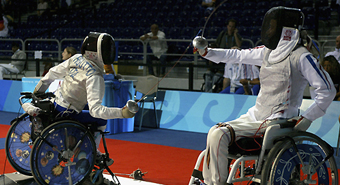
Participants compete in wheelchairs clamped into a metal frame. This gives the fencer maximum upper body movement along with full confidence that the chair will not move or tip over.There are three disciplines - Epee, Foil and Sabre.
Target areas for Foil and Sabre are the same as those for able-bodied Fencing. The target at Epee is everything from the waist upwards with a lamé apron worn to cancel out blows below the waist.
Bouts in the first round of competition are the best of nine hits. The top competitors are promoted to a direct elimination, where bouts are awarded to the first get to 15 hits.
Wheelchair Fencing at the Games
Wheelchair Fencing was part of the first Paralympic Games in Rome 1960.At the Paralympic Games in Seoul 1988, a new system of integrated classification for Wheelchair Fencing was introduced, which allows athletes with different disabilities (amputee, polio, cerebral palsy and paraplegia) the opportunity to compete together.
Facts about Wheelchair Fencing
- Frames are designed so that fencers can compete against each other whether they are right- or left-handed (so left vs right, right vs right, or left vs left).
- The distance between fencers at the start of a bout is decided by the fencer with the shorter arm. They can decide whether to fence at their own distance, that of their opponent or anywhere between the two.
- In 2006, the World Fencing Championships for able-bodied and wheelchair athletes were held alongside each other for the first time.
Get involved
For more information, visit the Great Britain Fencing Association (see 'related websites').Are you interested in...
Fencing
Related websites
- Great Britain Fencing AssociationOfficial site of the Governing body of the sport in England
- International Wheelchair Fencing CommitteeOfficial site of the international governing body
- Global governing body of the Paralympic movement
- Video of Paralympic sporting action provided by IPC
Related content
News
- Design teams shortlisted for temporary venues22 August 2007
- Coe commits to sustainable legacy4 May 2007
- Seeking temporary venues with flair3 May 2007
Back to the top
- Contact us
- Web accessibility statement
- Jobs
- Privacy policy
- Terms of use
- About this site
- Freedom of information
- Copyright

The official site of the London 2012 Olympic and Paralympic Games