


Taekwondo
Venues:
ExCeL
Dates: Thursday 9 August – Sunday 12 August
Gold medals: 8
Athletes: 128
Taekwondo: Then and now
The modern form of Taekwondo wasn’t agreed until 1955, but the sport has its roots in various Korean forms of martial arts stretching back more than 2,000 years.‘Taekwondo’ translates into English as “the art of the foot and the fist" – an accurate description of the way it is played.
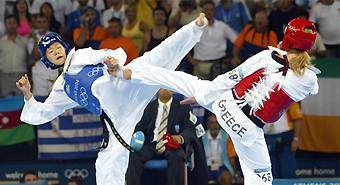
Powerful kicks and punches are literally the name of the game.
How to play – and win
The aim is to land accurate kicks on the scoring area of your opponent.The action takes place inside a 10 square metre-zone on a mat, in three rounds of two minutes each, if the match has not been decided after this match time the game has a further exciting sudden death round.
At the Olympic Games, events are held in four weight classes for both men and women. Competitors wear a white uniform called a ‘Dobok’, and protective equipment. One competitor wears red protection, the other blue, to help the judges tell the difference.
Taekwondo at the Games
For a young sport, Taekwondo was quick to make its Games debut. It featured as a demonstration event in Seoul 1988 and Barcelona 1992 before becoming a full medal sport at the Sydney 2000 Games. Taekwondo is popular worldwide, with many nations competing for the top place alongside the likes of Korea, China, USA and Iran. It is truly a world sport.
Facts about Taekwondo
- More than 50 million people in 157 countries around the world take part in Taekwondo.
- On average, it takes two or three years’ training to reach the ‘Black Belt’ status.
- There are only four weight divisions at the Olympic Games, compared to eight at the World Championships.
Jargon buster
- Deuk-jeom: A point.
- Gam-jeom: A one-point penalty.
- Chung: The contestant wearing blue.
- Hong: The contestant wearing red.
- Taekwonda: A Taekwondo athlete.
Get involved
For all the info you need to get fighting, contact the British Taekwondo Control Board (see 'related websites'). They will be able to give you the names and addresses of clubs in your local area. 
Related websites
- Includes a directory of UK Taekwondo clubs
- Official site of the International Federation
Related content
News
Blog
- DLR on track for 2012Posted by Robert, Development Projects Manager, DLR on 8 April 2008
- Accessing new ideas at Disability CapitalPosted by Mark Todd on 23 October 2007
- ExCel-lent triathlon action in LondonPosted by Nick Hockley on 9 August 2007
- Contact us
- Web accessibility statement
- Jobs
- Privacy policy
- Terms of use
- About this site
- Freedom of information
- Copyright

The official site of the London 2012 Olympic and Paralympic Games