- Skip to content
- Sitemap
- Help & Advice
- Login


- Email this page
- Print this page
Paralympic Equestrian
Venues:
Greenwich Park
Dates: Friday 31 August – Tuesday 4 September
Gold medals: 11
Athletes: 78
Equestrian: Then and now
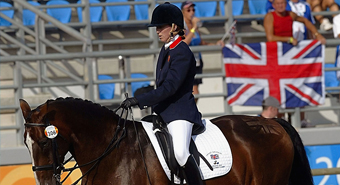
People with a disability have long taken part in Equestrian activities – originally as a means of rehabilitation and recreation.The sport of Para-Equestrian Dressage developed in the 1970s, with the first events held in Scandinavia and Great Britain.
Since then it has spread around the world, and athletes from more than forty countries now compete on a regular basis.
How to play – and win
Para-Equestrian Dressage does not differ from able-bodied Dressage in what is expected of the horse - i.e. the ‘way’ it performs.The horse and rider must be in harmony and the picture must be of lightness and rhythm. Athletes are judged according to how well they meet these requirements.
Para-Equestrian is a multi-disciplinary sport - all events are mixed, with athletes grouped according to their functional ability.
There are five grades (1a, 1b, 2 – 4), which determine the complexity of the movements the riders perform with their horses. This ensures that the competition can be judged on the skill of the competitor, regardless of their disability.
There are two competitions within each class – Individual and Freestyle.
The Individual Test is made up of set movements, while the Freestyle Test is performed to music, and competitors choose their own movements. A third competition is held to decide the Team medals.
Para-Equestrian Dressage at the Games
Para-Equestrian Dressage became a Paralympic sport at the Atlanta 1996 Games.Only 16 countries took part in the inaugural competition and it was vital that at least 24 teams participated in Sydney 2000 to allow Para-Equestrian Dressage to remain in the Games.
Thirty-four teams competed at Sydney, rising to 38 at Athens 2004, and the sport is now firmly established on the Paralympic programme.
The Athens 2004 Games were the first at which competitors were allowed to ride their own horses.
The change has brought Para-Equestrian Dressage closer to Olympic Dressage, where riders also form a partnership with a horse they ride and train consistently.
Facts about Para-Equestrian
- The first World Championships took place in Sweden in 1987.
- The competition arena measures 40m x 20m or 60m x 20m (depending on the grade).
- Visually impaired riders are permitted to use ‘callers’ to help orientate themselves around the arena. Norway’s Ann Cecile Orr rode to a whistle on her way to winning two silver medals at Sydney 2000 – she is totally blind.
Get involved
The Riding for the Disabled Association has groups up and down the United Kingdom. Find out where you can learn to ride by visiting their website (see 'related websites').Are you interested in...
Equestrian
Related websites
- Contains a riding group locator and information about upcoming events
- British Dressagethe National Governing Body for both able-bodied Dressage and Para-Equestrian Dressage in Britain
- Global governing body of the Paralympic movement
- Video of Paralympic sporting action provided by IPC
Related content
News
- Lee Pearson wins ninth Paralympic medal11 September 2008
- LOCOG discusses Equestrian venue with Greenwich societies18 July 2008
- London 2012 commits to Greenwich consultation26 June 2008
Blog
- Sunday afternoon in GreenwichPosted by Comfort, Community Relations Executive on 9 October 2008
- A great Equestrian showPosted by Terry, London 2012 Legal team on 14 September 2008
- Visiting the Equestrian venue in Hong KongPosted by Derek, LOCOG Venues team on 15 August 2008
Back to the top
- Contact us
- Web accessibility statement
- Jobs
- Privacy policy
- Terms of use
- About this site
- Freedom of information
- Copyright

The official site of the London 2012 Olympic and Paralympic Games