- Skip to content
- Sitemap
- Help & Advice
- Login


- Email this page
- Print this page
Paralympic Cycling
Venues:
Olympic Park Velodrome (Track), Regents Park (Road)
Dates: Thursday 30 August – Friday 7 September
Gold medals: 27
Athletes: 150
Cycling: Then and now
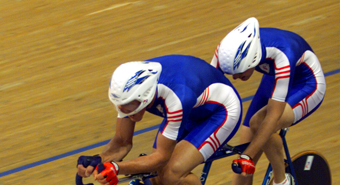
The thrill of two and three-wheeled racing is quite new for athletes with a disability.Paralympic Cycling was originally developed as a sport for blind athletes, who first competed using tandem bicycles.
Technological advancements have since opened the sport up to a wider range of categories, fuelling rapid growth in the number of events and the standard of competitors over the last three decades.
How to play – and win
Races are held on the road and the track, with events for both individuals and teams.Competitors in different disability classes use bicycles, tricycles, tandems and handcycles, and are grouped together according to their functional ability.
Paralympic Cyclists compete under exactly the same rules and conditions as their counterparts at the Olympic Games.
Cycling at the Games
Cycling was introduced as a Paralympic sport at the Seoul 1988 Games, where only road events were contested.At Barcelona 1992, competitors from different disability groups competed together for the first time. The first Track races took place at Atlanta 1996.
Facts about Paralympic Cycling
- Athletes from more than forty countries compete in Paralympic Cycling.
- Handcycling – for athletes with lower limb disabilities – was introduced at the Athens 2004 Games.
- Cyclists must wear protective helmets, the colour of which reflects their class.
Get involved
Disability Cycling is growing fast. If you want to get in on the action, contact British Cycling who will put you in touch with the people you need to know (see 'related websites').Are you interested in...
Cycling
Related websites
- British CyclingIncludes a specialist disability cycling section with contact details for getting involved
- A resource for local links
- Global governing body of the Paralympic movement
- Video of Paralympic sporting action provided by IPC
Related content
News
- Search for timber suppliers begins4 March 2008
- ‘VeloDream’ winners announced28 February 2008
- Demolition on ‘big 5’ venues complete19 December 2007
Blog
- UK cycling hits gold with VeloPark plansPosted by Chris Hoy on 10 April 2008
- Thrilled to be short listed for VeloDreamPosted by Little Harrowden Primary School on 17 March 2008
- Positive news for WalesPosted by Angela Salt on 5 March 2008
Back to the top
- Contact us
- Web accessibility statement
- Jobs
- Privacy policy
- Terms of use
- About this site
- Freedom of information
- Copyright

The official site of the London 2012 Olympic and Paralympic Games