- Skip to content
- Sitemap
- Help & Advice
- Login


- Email this page
- Print this page
Boccia
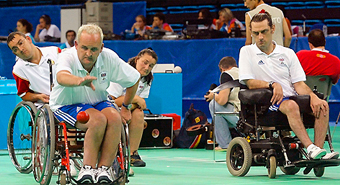
Boccia: Then and now
Boccia is a sport with ancient Greek origins – it was developed from a traditional ball tossing game by Italians in the 16th century.Today, Boccia is unique to the Paralympic Games, where it is played by wheelchair athletes with severe cerebral palsy and related neurological disorders.
The sport is a test of muscle control and accuracy, demanding extreme skill and concentration at the highest level.
How to play – and win
Boccia is played on a long, narrow court by individuals, pairs and teams. The goal is to throw or bowl a ball so that it lands as close as possible to the target ball, called a ‘jack’.At the end of every round, the competitor whose ball is closest to the jack scores one point for every one of his balls that is closer than his opponent’s.
A game consists of four ends in individual and pairs competitions; there are six ends in team events.
Boccia at the Games
Boccia was introduced at the New York 1984 Paralympic Games. Today, there are seven medal events in the programme – all of which are open to athletes of either sex. Portugal has traditionally been the strongest Boccia nation.Facts about Boccia
- Boccia is played in 42 countries.
- A Boccia court measures 12.5m x 6m.
- ‘Boccia’ comes from the Latin word ‘bottia’, meaning ‘ball’. The sport is also known as ‘bocce’.
Get involved
Boccia is truly a sport for all. A game of skill, it can be played together by men and women of all ages - with or without a disability.
CP Sport is the National Governing Body of Boccia in the United Kingdom (see 'Related websites').
Related websites
- CP SportOfficial site for Boccia in the UK
- Global governing body of the paralympic movement
- Video of the Paralympic sporting action provided by IPC
Related content
News
- IOC approves changes to Park venues5 June 2008
- London Triathlon attracts top competitors
- London named as 2011 Worldskills host
Blog
- DLR on track for 2012Posted by Robert, Development Projects Manager, DLR on 8 April 2008
- Accessing new ideas at Disability CapitalPosted by Mark, ODA Principal Access and Inclusions Officer on 23 October 2007
- ExCel-lent triathlon action in LondonPosted by Nick, Commercial team on 9 August 2007
Back to the top
- Contact us
- Web accessibility statement
- Jobs
- Privacy policy
- Terms of use
- About this site
- Freedom of information
- Copyright

The official site of the London 2012 Olympic and Paralympic Games