- Login / Sign up
- English
- Français




Aquatics: Then and now
People have swum across lakes and rivers since prehistoric times, but the first organised races did not take place until the 19th century, when the National Swimming Society of Great Britain was created.None of the four Aquatics disciplines – Swimming, Diving, Synchronised Swimming and Water Polo – has been around for longer than 200 years as a competitive sport.
There were still no official rules or standards when Aquatics featured in the programme for the first modern Olympic Games in Athens 1896, Paris 1900 and St Louis 1904.
The Federation Internationale de Natation (FINA) was formed during the London 1908 Olympic Games competition to act as a governing body for the sport.
How to play – and win
Swimming
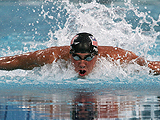
Traditional Swimming races take place over distances ranging from 50m to 1500m. Unless it is a Freestyle event, competitors have to use a particular swimming stroke: Breaststroke, Butterfly or Backstroke. There are also Medley events which combine all three strokes.Olympic races take place in a 50m long pool divided into 10 lanes, with only the middle eight lanes used by swimmers. The swimmer who touches the pool wall first at the end of the race is the winner.
A 10km Open Water race has been added to the Swimming programme for the Beijing 2008 Games. Open Water races are swum outside in areas such as the sea, a lake or a river, and competitors usually swim 2.5km circuits around buoys positioned in the water.
Diving
Diving is closely linked to Gymnastics. Competitors jump head-first into a pool from a three-metre springboard or a 10-metre solid platform. They perform a series of twists and somersaults before they hit the water.The aim is to win as many points as possible from a panel of judges who assess each dive for difficulty and style of execution.
As well as individual competitions, there are also Synchronised Diving events, in which pairs of athletes dive in tandem and receive an additional mark for their level of ‘synchronisation’.
Synchronised Swimming
Synchronised Swimming is for women only. It is sometimes called ‘water ballet’, as competitors perform short routines to music in the pool. Routines are judged on technical merit and artistic impression.There are two events: Duet (for pairs) and Team (for groups of eight).
In each, the winner is the one who gets the most points from the judges based on how well they perform the moves, and how well the routine is put together.
Water Polo
Water Polo is a water-based version of Handball. The aim of the game is to score more goals than the other team by putting the ball in the back of a net that sits on top of the water and is three metres wide and 90 centimetres high.Each team only has 30 seconds to score before the ball is passed to the opposition. As well as ball skills, players need stamina: you are not allowed to touch the bottom or the side of the pool during a match, which lasts for four periods of seven minutes each.
Aquatics at the Games
At the first three modern Olympic Games, Swimming took place in open water - in seas, rivers and lakes. A pool was used for the first time at the London 1908 Games, where the rules were finally standardised.Diving has been part of the Games since St Louis 1904, although Synchronised Diving events have only been held since Sydney 2000.
Synchronised Swimming, by contrast, featured as far back as London 1948, but the sport did not achieve medal status until Los Angeles 1984.
The newest Aquatics event in the Games is Women’s Water Polo, which was introduced in Sydney 2000 - 100 years after the first men’s competition took place in Paris 1900.
Facts about Aquatics
- Japan won all but one of the men’s Swimming titles at the Los Angeles 1932 Olympic Games.
- The swimming pool for the London 1908 Olympic Games was built inside the Athletics track.
- The first official tie in Olympic Swimming history came in Los Angeles 1984, when American teammates Nancy Hogshead and Carrie Steinseifer proved inseparable in the 100m Freestyle event.
- Top Water Polo players swim five kilometres (three miles) in the course of a match.
- The United States won every Swimming event at the London 1948 Games.
- Johnny Weissmuller, the first man to swim 100 metres in under a minute, was just as famous out of the pool. He helped save the lives of 11 people when a boat capsized on Lake Michigan, and also played the role of Tarzan in films.
- Underwater Swimming featured at the Paris 1900 Games. Competitors earned points for the length of time and distance they were underwater.
- Synchronised Swimming began as a sport for men in the 1800s. But only women are eligible to compete at the Olympic Games.
- The ‘crawl’ technique used in Freestyle Swimming was developed by a British Swimming instructor called J. Arthur Trudgeon. He based it on a native American style of Swimming that he had discovered during a trip to South America in the 1870s.
- Water Polo developed in England in the 19th century, and Great Britain won four of the first five Olympic Water Polo tournaments.
- The most famous Olympic Diving incident took place at Seoul 1988. It involved the USA’s Greg Louganis, who fell, unconscious, into the pool after hitting his head on the 3m springboard at the start of a qualifying dive. Amazingly, he recovered to win the gold medal in the final.
Jargon Buster
- Eggbeater: A powerful way of treading water, used in Synchronised Swimming and Water Polo.
- Pike: A Diving position where the body is bent at the hips with the legs straight.
- Negative split: A race strategy in which a competitor swims the second half of a race faster than the first half.
- Tumble turn: An underwater roll at the end of a lap that allows a swimmer to push off from the end of the pool with his feet.
- Dry pass: A pass in Water Polo that is designed to be caught before the ball hits the water.
Get involved
To get started in Aquatic sports, head down to your local pool. If you want to know more about clubs, facilities and coaching schemes in your area, contact your national federation see 'related websites'.Are you interested in...
Paralympic Swimming
Related websites
- Provides information about swimming in the UK, including links to clubs
- Gives details of clubs, competitions and events in Scotland
- Includes a directory of Welsh clubs and a calendar of swimming meets and events
- Provides a list of Ulster swimming clubs and club secretaries
- SwimfitProvides advice for ASA members about swimming fitness programmes
- Official website for the international swimming federation
- Active PlacesSearch for pools in your area (England only)
Related content
- Paralympic Swimming
News
- British Swimming Team visit Olympic Park to see Aquatics Centre progress11 May 2009
- Olympic Park images released as IOC visits London21 April 2009
- Raising the roof on the Aquatics Centre31 March 2009
Blog
- 2012's Modern Pentathlon venues are fit for the peoplePosted by Klaus, president of the International Union of Modern Pentathlon on 21 May 2009
- British swimming team visit the ParkPosted by Charlotte O'Neill on 15 May 2009
- 2012 and a sporting future for LondonPosted by Kate Hoey, Mayor's Commissioner for Sport on 7 May 2009
- Contact us
- Web accessibility statement
- Jobs
- Privacy policy
- Terms of use
- Using this site
- Freedom of information
- Copyright

The official site of the London 2012 Olympic and Paralympic Games